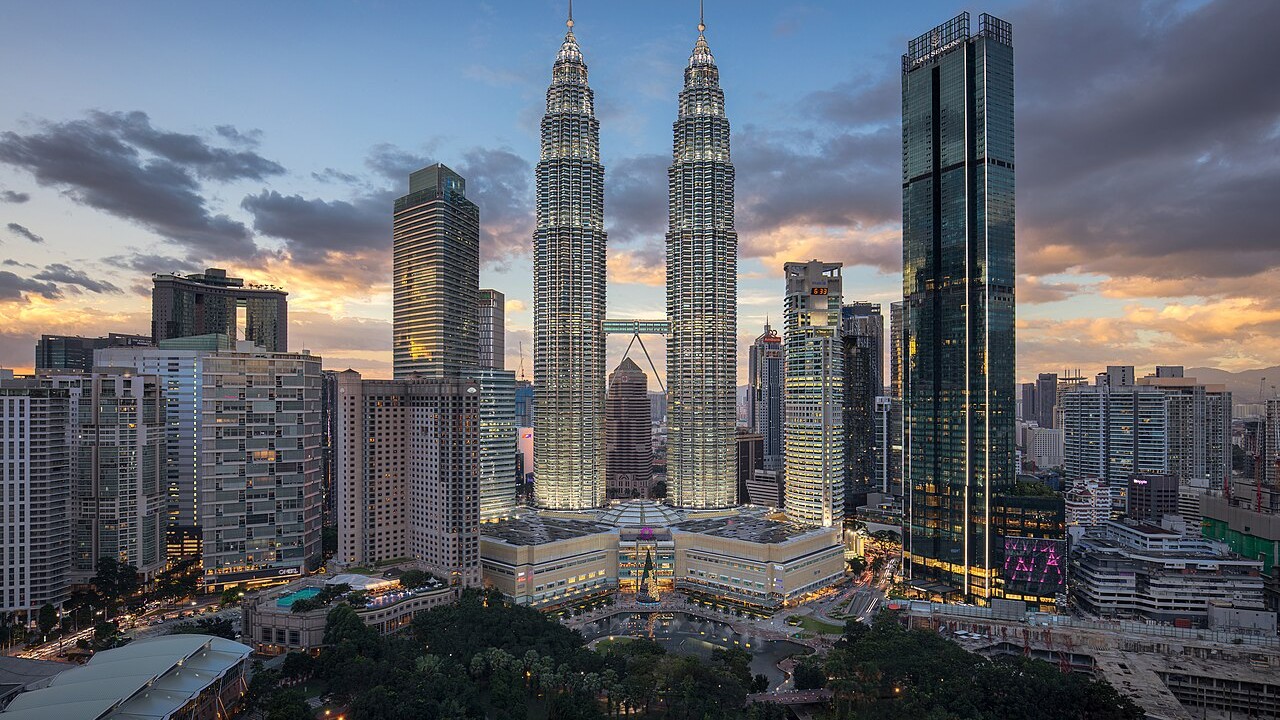
The Geometry of Faith and Function
The Petronas Twin Towers\' floor plan is one of the most recognisable shapes in modern architecture: an eight-pointed star formed by overlapping two rotated squares, with semicircular infills smoothing the inner angles. This form is the Rub el Hizb, a symbol deeply embedded in Islamic art and manuscript illumination traditions. C\u00e9sar Pelli chose it not as ornament but as organising principle — the geometry dictated the structural column placement, the curtain wall module, and the building\'s distinctive stepped massing.
The beauty of Pelli\'s insight was that the Islamic star proved functionally superior to a conventional rectangular plan for several reasons. The sixteen points of the star provided natural locations for perimeter columns, distributing gravity loads more evenly than a rectangular arrangement. The re-entrant corners created natural locations for building services without interrupting the floor plate. And the stepped silhouette produced by reducing the star\'s diameter at setback levels reduced wind loading on the upper storeys while creating the towers\' graceful tapering profile.
The Great Material Debate
The single most consequential engineering decision in the towers\' design was the choice to build in high-strength reinforced concrete rather than structural steel. This was controversial — every supertall building over 400 metres at the time used a steel structural frame. Charles Thornton of Thornton Tomasetti argued passionately for concrete, citing three advantages that proved decisive.
First, concrete\'s inherent mass provides natural damping against wind-induced oscillation — critical in Malaysia\'s equatorial climate where sustained monsoon winds can cause uncomfortable sway in lighter steel structures. Second, concrete could be sourced locally from Malaysian aggregate and cement suppliers, while structural steel would need to be imported at vastly greater expense. Third, Malaysia\'s construction workforce had deep experience with concrete but limited familiarity with the complex welded connections required for steel supertalls.
The concrete mix design pushed material science to its limits. Base columns used concrete with compressive strengths of 80 MPa — roughly twice the strength of standard structural concrete — incorporating silica fume and fly ash to achieve density and flowability. The mix had to remain workable during the hours required to pump it hundreds of metres vertically, then cure to extraordinary strength. Getting this chemistry right required months of laboratory testing and trial pours.
The Skybridge: Connecting Giants
Perhaps no element of the towers captures the public imagination like the Skybridge — a 58-metre, double-deck span connecting the towers at the 41st and 42nd floors, approximately 170 metres above the street. The bridge serves both practical purposes (emergency evacuation between towers) and symbolic ones (unity between the twin structures).
The engineering challenge was formidable. Each tower is designed to move independently under wind loading, with potential differential sway of up to one metre at the bridge level during severe storms. A rigid connection would transmit enormous forces between the towers, potentially destabilising both. The solution was a pin-jointed system with spherical bearings at each end, allowing the bridge to slide horizontally along steel rails while maintaining structural integrity. The bridge effectively floats between the towers, rising and falling slightly with their independent movements.
Installation was a construction spectacle. The 750-tonne bridge was fabricated at ground level in two halves, then lifted into position over a single weekend using strand-jacking systems that inched the sections upward with hydraulic precision. Thousands of spectators gathered to watch from the streets below. When the two halves met and were bolted together, the moment felt less like an engineering milestone and more like the completion of something ceremonial.
The Skin That Shimmers
The towers\' exterior cladding — approximately 83,500 square metres of glass and stainless steel per tower — was as carefully considered as the structure it conceals. Fabricated by Italian specialist Permasteelisa, the unitised curtain wall system combines laminated insulating glass with stainless steel spandrel panels in both brushed and polished finishes. The result is a facade that changes character throughout the day: silver-grey under overcast skies, golden during the tropical sunset, and luminous at night when interior lighting transforms the towers into twin columns of warm light.
The stainless steel was chosen for its ability to withstand Malaysia\'s aggressive tropical climate without the painting and maintenance cycles that painted aluminium would require. After 25 years of exposure to equatorial sun, monsoon rain, and urban pollution, the original cladding panels remain in excellent condition — a vindication of the material specification that some initially considered extravagant.