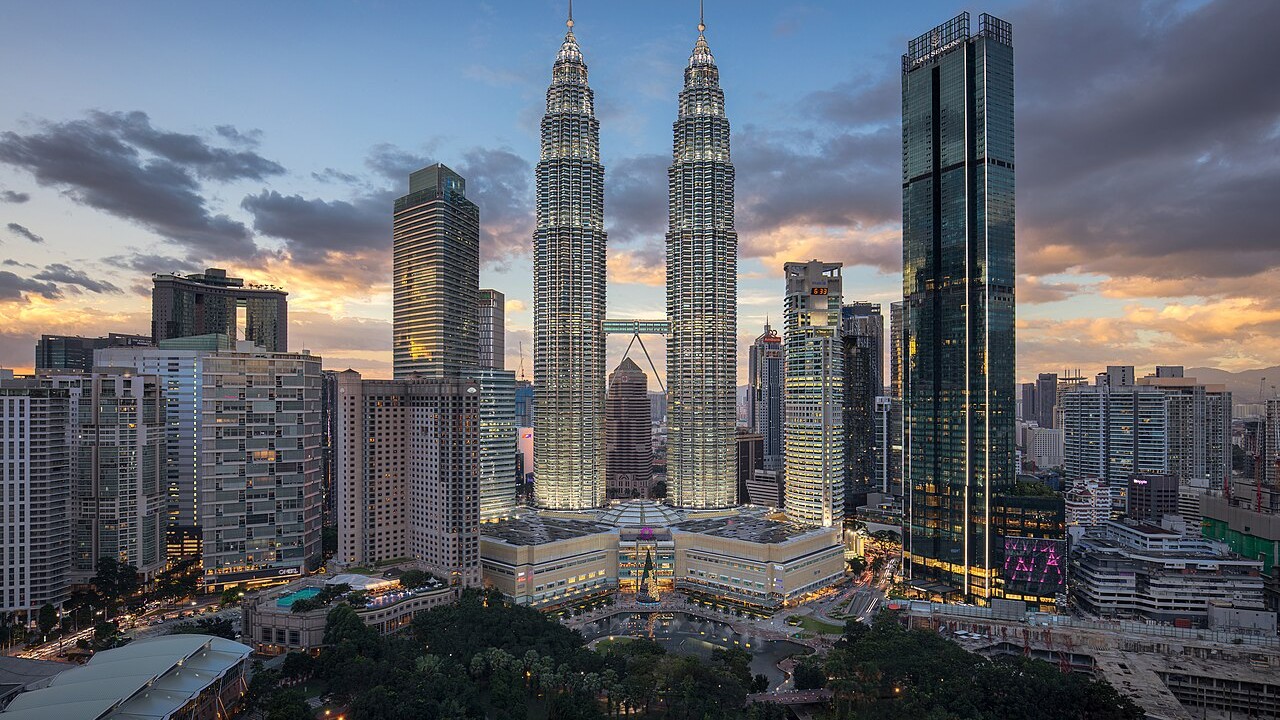
A Dream Takes Shape in the Tropics
Malaysia in the late 1980s was a country in motion. Under Prime Minister Mahathir Mohamad\'s forceful leadership, the nation was shedding its identity as a sleepy commodity exporter and reaching for something altogether more ambitious. Mahathir envisioned a Malaysia that would stand shoulder-to-shoulder with the world\'s advanced economies by the year 2020 — and he understood that physical symbols matter. A nation needs landmarks that embody its aspirations, structures that say to the world: we are here, we are serious, we are capable of extraordinary things.
The 100-acre site chosen for this statement was the Selangor Turf Club, a horse racing venue in the heart of Kuala Lumpur that dated to the British colonial era. The symbolism was not lost on anyone: Malaysia would replace a colonial leisure ground with the centrepiece of its post-colonial reinvention. PETRONAS, the national petroleum corporation flush with hydrocarbon revenues, would anchor the development as primary tenant and sponsor. The brief to architects was deceptively simple: design something that is unmistakably Malaysian and unequivocally world-class.
Eight Architects, One Extraordinary Brief
In 1991, eight internationally renowned architectural practices were invited to submit competing visions for the KLCC towers. The roster read like an honour roll of late twentieth-century architecture: Norman Foster, Kisho Kurokawa, Paul Rudolph, and five other luminaries each presented their interpretation of what a Malaysian skyscraper should look like. Some proposed soaring glass monoliths in the international modernist tradition; others experimented with vernacular tropical forms.
The winning entry, by Argentine-American C\u00e9sar Pelli, stood apart because it solved a problem the other entries had not fully grasped. Pelli recognised that a tower claiming to represent Malaysia could not simply be tall — it had to be culturally legible. His floor plan, based on two interlocking squares forming an eight-pointed Islamic star, was a stroke of conceptual brilliance. The geometry was ancient and sacred, but the resulting building was defiantly modern. When Mahathir saw the design, he reportedly said: "This is the one. This is us."
Wrestling with the Earth Below
The romance of architectural vision collided sharply with geological reality when site investigations began in 1993. Engineers discovered that the limestone bedrock beneath the site was wildly uneven, plunging to depths exceeding 200 metres beneath the planned Tower 2 location. Building the world\'s tallest towers on such treacherous ground seemed borderline reckless. The entire project footprint was shifted 60 metres southeast to find more reliable geology — a decision that required redesigning underground infrastructure already in progress.
Even after the relocation, Tower 2\'s foundation demanded extraordinary measures. Over a hundred massive barrette piles were driven to depths of 60–115 metres, creating a forest of concrete pillars that would anchor the tower in the soft alluvial deposits above bedrock. Each tower\'s foundation raft consumed more than 13,000 cubic metres of concrete, poured continuously for over two days. When the engineers finally declared the foundations complete, the invisible work beneath the ground had already established several world records.
Two Teams, One Race to the Sky
What happened next was unprecedented in construction history. Instead of awarding both towers to a single contractor, the developers gave Tower 1 to a Japanese consortium led by Hazama Corporation and Tower 2 to a Korean consortium led by Samsung Engineering & Construction. Whether this was pragmatic necessity (no single firm had the capacity for both) or deliberate strategy to create healthy competition, the result was electrifying.
The two teams worked side by side yet independently, each determined to outpace the other. The Japanese team favoured meticulous planning and traditional climbing formwork; the Koreans deployed an aggressive automated system that proved faster in the upper floors. At the peak of construction, a new floor was completed every four days on each tower. Workers from over twenty countries laboured through tropical heat, afternoon thunderstorms, and the vertigo of working hundreds of metres above the Kuala Lumpur streets.
The race produced moments of high drama. At one point, Tower 2 was discovered to have a slight lean — imperceptible to the naked eye but alarming when measured with surveying instruments. The Korean team was forced to pause and correct the alignment over several anxious weeks before resuming the climb upward. Both towers topped out structurally in early 1996, and the decorative stainless steel pinnacles were hoisted into position by year\'s end, each one weighing 176 tonnes and gleaming like a spear of light against the tropical sky.
Inauguration Amid the Storm
The towers were officially inaugurated on 28 August 1999, in circumstances that added poignancy to triumph. The 1997 Asian financial crisis had devastated regional economies, and many had predicted the Petronas project would become a monument to overreach. Instead, Malaysia completed the towers without halting construction — an act of economic defiance that the international press alternately admired and questioned. On inauguration day, Mahathir stood beneath the Skybridge and spoke of the towers as proof that economic crisis could not break a nation that believed in its own future. Whether one agreed with the politics or not, the towers themselves were beyond argument: they were magnificent.